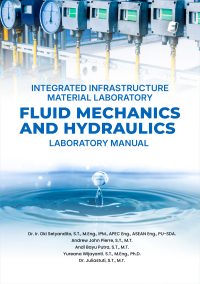
Integrated Infrastructure Material Laboratory Fluid Mechanics and Hydraulics Laboratory Manual
Author: Dr. Ir. Oki Setyandito, S.T., M.Eng., IPM., APEC Eng., ASEAN Eng., PU-SDA.; Andrew John Pierre, S.T., M.T.; Andi Bayu Putra, S.T., M.T.; Yureana Wijayanti. S.T., M.Eng., Ph.D.; dan Dr. Juliastuti, S.T., M.T. Publisher: Filosofis Indonesia Press Published: February 2, 2026 Country: Daerah Istimewa Yogyakarta Language: Indonesia Dimension: A5 More DetailsThe Integrated Infrastructure Material Laboratory: Fluid Mechanics and Hydraulics Laboratory Manual serves as an essential practical guide for engineering students and professionals to bridge the gap between theoretical fluid mechanics and real-world infrastructure applications. By moving beyond abstract equations, this manual provides a hands-on framework for understanding how fluids interact with various materials and structures. It is meticulously designed to foster a deep comprehension of fluid behavior, which is critical for the design, maintenance, and innovation of modern civil and environmental engineering projects.
The core of the manual is structured around a series of progressive experiments, ranging from fundamental fluid properties to complex hydraulic phenomena. Readers are guided through rigorous testing of hydrostatic pressure, buoyancy, and flow measurement techniques using devices such as Venturi meters and orifices. Furthermore, the manual delves into the dynamics of pipe flow—analyzing energy losses due to friction—and open channel hydraulics, where students can observe hydraulic jumps and the function of weirs in water management. This systematic approach ensures that users not only learn the “how” of laboratory procedures but also the “why” behind fluid dynamics.
What sets this manual apart is its specific focus on the integration of material science within hydraulic systems. It emphasizes the critical relationship between the physical properties of infrastructure materials and their hydraulic efficiency and durability. Each module includes concise theoretical backgrounds, standardized data collection sheets, and safety protocols, making it a turnkey resource for academic institutions. Ultimately, the manual prepares future engineers to tackle global challenges in water distribution, drainage systems, and sustainable infrastructure development with technical precision and analytical rigor.